PABLO RODRÍGUEZ OVALLE / RESEARCH

Research

RESEARCH

Planetary atmospheres.

Infrared spectroscopy · Atmospheric retrievals · Radiative transfer

I study near- and mid-infrared spectra to investigate the thermal structure and composition of planetary atmospheres, particularly their middle and upper layers. My research includes the identification and interpretation of auroral effects associated with energetic particle precipitation, and the study of atmospheric variability using space-based observations.

Saturn observed with the James Webb Space Telescope NIRCam
Saturn with JWST/NIRCam · NASA/ESA/CSA/STScI
01 — GIANT PLANETS

Giant planets

I investigate giant-planet atmospheres with observations from the James Webb Space Telescope, including NIRSpec and MIRI, with a particular focus on Jupiter.

My work examines atmospheric temperature, composition and auroral processes. In particular, I investigate how energetic particle precipitation modifies the thermal and chemical structure of Jupiter's upper atmosphere.

Related research ↗
ESA illustration of ExoMars Trace Gas Orbiter measuring the Martian atmosphere
ExoMars TGO · ESA/ATG medialab (illustration)
02 — MARS

Mars

I use observations from the ExoMars Trace Gas Orbiter to analyse the climatology of carbon monoxide (CO) in the Martian atmosphere.

Using solar-occultation spectra from ACS-MIR, I work on precise retrievals of CO vertical profiles and their seasonal and spatial variability. My aim is to push the spectroscopic analysis of these measurements, including instrument characterization and spectral corrections, to extract as much information as possible.

Related research ↗
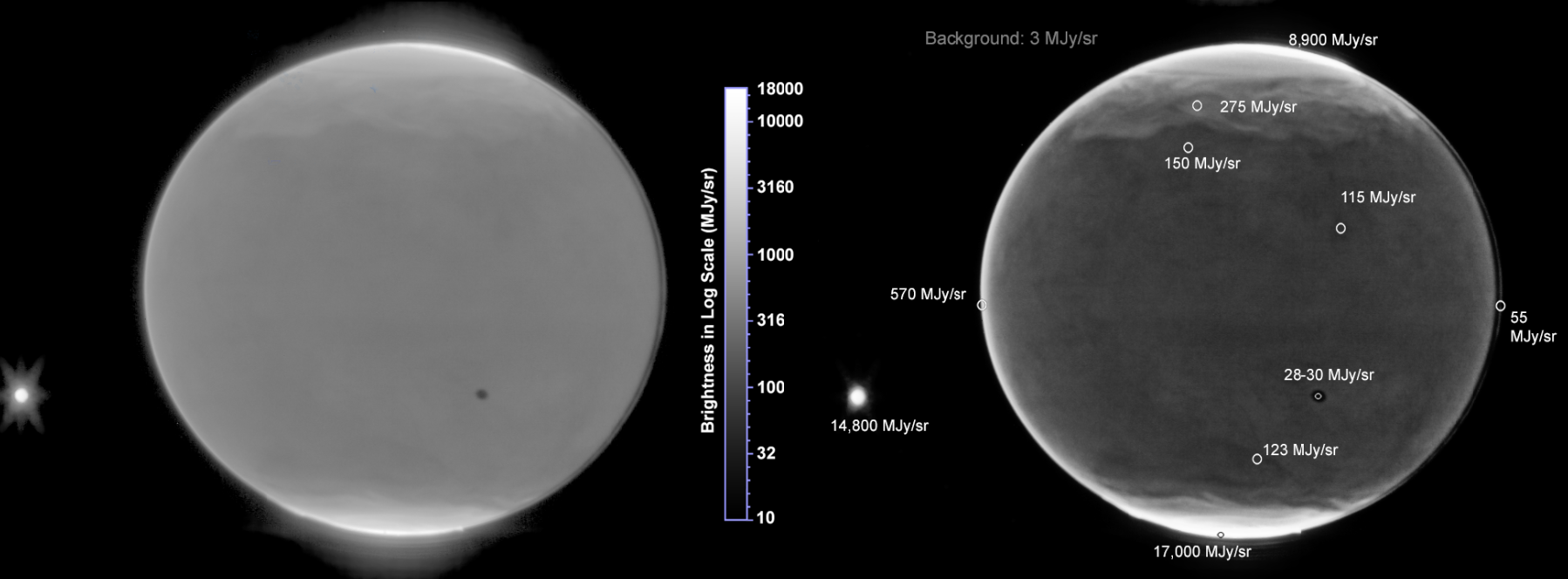
Infrared observations of Jupiter showing atmospheric emission and non-LTE effects
JWST/MIRI observations of Jupiter · Non-LTE emission
03 — METHODS

Methods

I analyse near- and mid-infrared spectra using radiative-transfer methods under local thermodynamic equilibrium (LTE) and non-LTE conditions.

My work combines forward spectral modelling, atmospheric retrievals and careful treatment of instrumental effects to constrain thermal profiles and molecular abundances from observations.

Referenced A&A article ↗